
AI Data-Center Boom Faces New Political Headwinds After U.S. Midterms
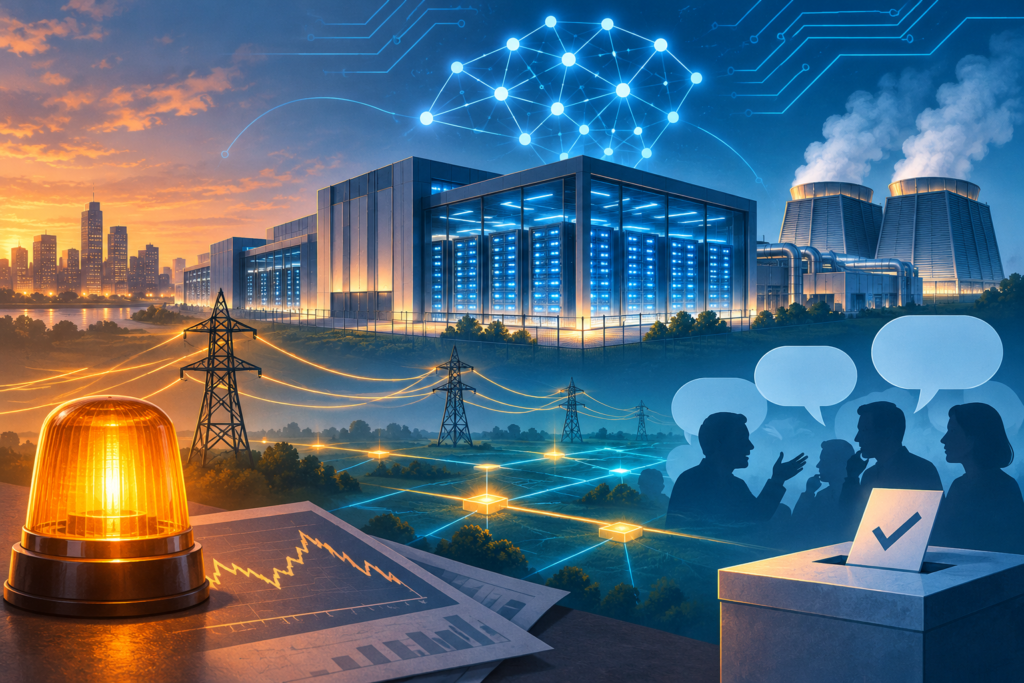
The artificial-intelligence infrastructure boom is facing a new source of uncertainty: whether political pressure and local opposition will slow the construction of data centers and the power systems they need.
Investors reacted sharply this week as U.S. midterm results reshaped expectations for Washington and state-level policy. On Thursday, South Korea’s Kospi fell 5.3%, while shares of Samsung Electronics and SK Hynix dropped 7.6% and 9.4%, respectively. Those moves came amid wider volatility in AI-linked stocks, though daily market swings can reflect many forces at once. The Associated Press reported that investors were weighing the potential effect of a Democratic-led Congress on the AI investment boom.
Data-center projects face local scrutiny
The debate extends beyond federal policy. Local campaigns and voter measures have increasingly focused on the energy, water, land use and household costs associated with large data centers. Axios reported Thursday that election outcomes and local referendums could affect some planned projects, while citing JPMorgan analysis that identified possible pauses or added conditions for portions of future U.S. capacity. Those figures are projections, not enacted restrictions, and many projects remain on track.
For technology companies, the question is how to balance the race to build AI computing capacity against the cost and time required to secure electricity, permits and community support. A slower expansion could ease pressure on grids and reduce the risk of investing too quickly in equipment, but it could also delay projects and revenue for data-center operators and suppliers.
What to watch next
The near-term test will be whether election promises turn into legislation, permitting changes or local agreements. Investors will also watch whether major technology firms adjust capital-spending plans, and whether utilities can deliver power to projects already under construction. For now, the market reaction signals uncertainty about the pace of AI infrastructure growth, rather than proof that the buildout has stopped.
Sources: Associated Press, “World shares mostly gain after US midterm elections as AI-related stocks sink” (Nov. 5, 2026); Axios, “Why this could be the AI pause that refreshes” (Nov. 5, 2026).
