
Global Fossil-Fuel CO₂ Emissions Forecast to Dip 0.4% in 2026
A preliminary 2026 Global Carbon Budget estimate projects that emissions from fossil fuels and cement will edge down 0.4% this year. The researchers say the central estimate reflects both expanding clean energy and an oil-demand shock tied to the Iran conflict and disruption around the Strait of Hormuz. The projection is not yet a confirmed annual total, and it does not mean all carbon dioxide emissions are falling.
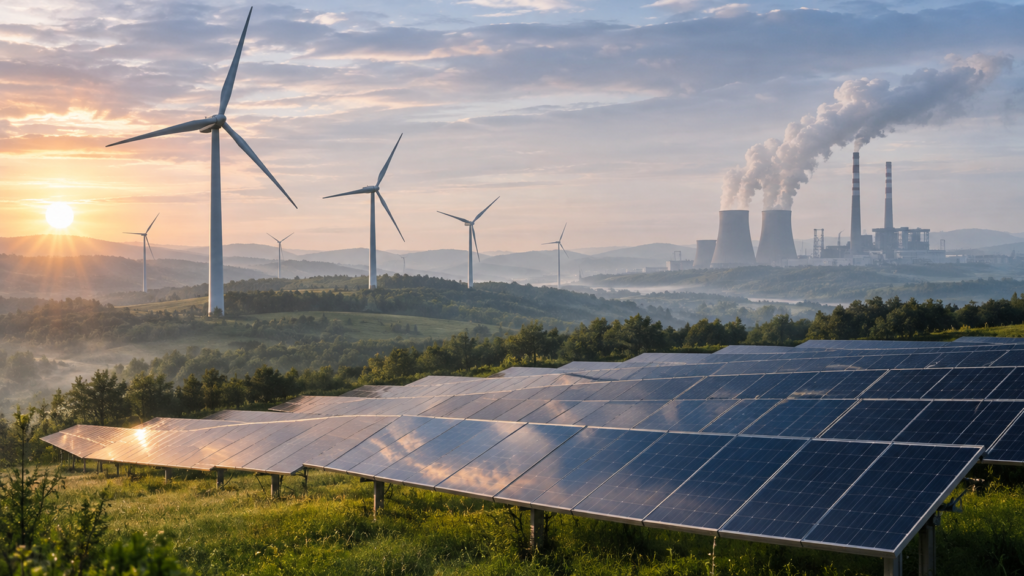
What the 2026 carbon estimate shows
The Global Carbon Project’s central projection puts fossil-fuel and cement emissions at about 38.2 billion metric tons of CO₂ in 2026, down from a record estimate for 2025. The study is a preprint currently under review, and the authors give a range from a 1.5% decline to a 0.6% increase. That uncertainty means a small rise remains possible.
The projected shift is uneven across fuels: oil-related emissions are expected to fall 1.9% and natural-gas emissions 0.3%, while coal emissions are forecast to rise 0.6%. Researchers link much of the oil decline to higher prices and supply disruption after the Iran conflict affected traffic through the Strait of Hormuz. The estimate therefore combines structural clean-energy growth with a geopolitical shock that may not persist.
Why a fossil-fuel dip does not mean total emissions fell
The fossil-fuel figure is only one part of the carbon budget. When emissions from land-use change are included, the project estimates total human-caused CO₂ emissions could reach about 43.3 billion metric tons in 2026, above roughly 42.8 billion in 2025. Peat fires and forest degradation in Southeast Asia are among the factors pushing the land-use estimate higher.
That distinction matters: a lower central estimate for fossil emissions can coexist with a record projection for total CO₂. The project also estimates that atmospheric CO₂ will continue to rise, reaching about 427.7 parts per million this year. These figures are preliminary projections, not a final measurement of the full year.
Clean energy is growing, but the trend is not locked in
Solar, wind and electric vehicles are increasingly meeting new energy demand, but the accompanying research says their expansion has not yet been sufficient to guarantee a sustained global emissions decline. The 2026 estimate is a one-year forecast shaped partly by fuel prices and supply constraints, so it should not be read as proof that the world has reached a lasting emissions peak.
The Global Carbon Budget is released during the annual U.N. climate negotiations, where countries weigh long-term energy plans against short-term disruptions. For more coverage of international climate developments, visit The Globuzz’s World section.
Sources
Associated Press; Global Carbon Budget 2026 preprint; Reuters reporting, republished by Yahoo; Carbon Brief analysis; ABC News Australia.
