
Voyager 1 Is Set to Reach One Light-Day From Earth on Nov. 18
NASA’s Voyager 1 spacecraft is expected to reach a distance of one light-day from Earth on Nov. 18, a milestone that will put a 24-hour delay between a signal leaving the spacecraft and reaching antennas on Earth. The probe will be about 16.094 billion miles (25.902 billion kilometers) away, according to NASA.
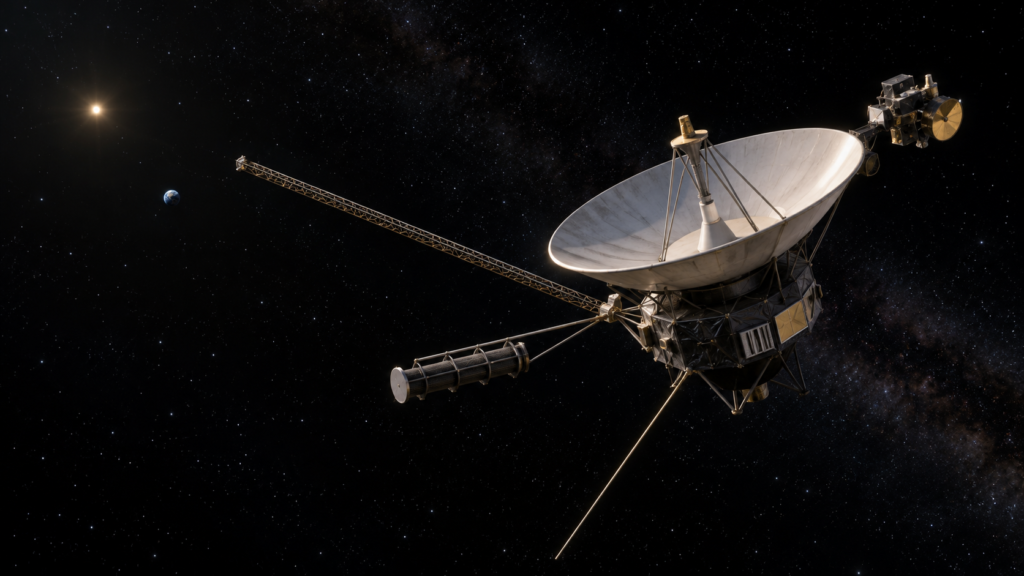
What one light-day means for Voyager 1
A light-day is a measure of distance: it is how far light travels in 24 hours. Because radio messages travel at the speed of light, a command sent from Earth after the milestone will take about a day to reach Voyager 1, and a reply will take about another day to return. That makes a round-trip exchange roughly 48 hours before accounting for processing time.
NASA’s forecast puts the crossing at 2:16:07 a.m. Pacific time on Nov. 18, or 10:16:07 UTC. The figure is an estimate tied to the spacecraft’s continuing outward journey, rather than a change in its mission or a new communications capability.
A landmark nearly five decades after launch
Launched in 1977, Voyager 1 crossed the heliosphere’s boundary into interstellar space in 2012. The one-light-day mark will be the first time a human-made object has reached that distance from Earth. Its twin, Voyager 2, is on a similar path but is not expected to reach one light-day until 2035, NASA says.
The milestone also gives a simple way to understand the scale of deep-space operations: even a near-instant radio signal becomes a day-long message in one direction. Readers can follow other current developments in Today’s News.
Sources
Associated Press: NASA’s Voyager 1 is about to reach a mega milestone.
Reuters: NASA’s Voyager 1 probe poised to achieve mega-distance milestone.
NASA: Voyager 1 and Voyager 2 current distance information and one-light-day milestone details.
