
SpaceX Catches Starship’s Upper Stage After 22-Hour Flight
SpaceX’s Starship upper stage returned from orbit and was caught by the launch tower’s mechanical arms at Starbase, Texas, on Nov. 14, completing a roughly 22-hour test flight. The catch was a first for the spacecraft—but Flight 15 did not complete the planned recovery of both rocket stages.
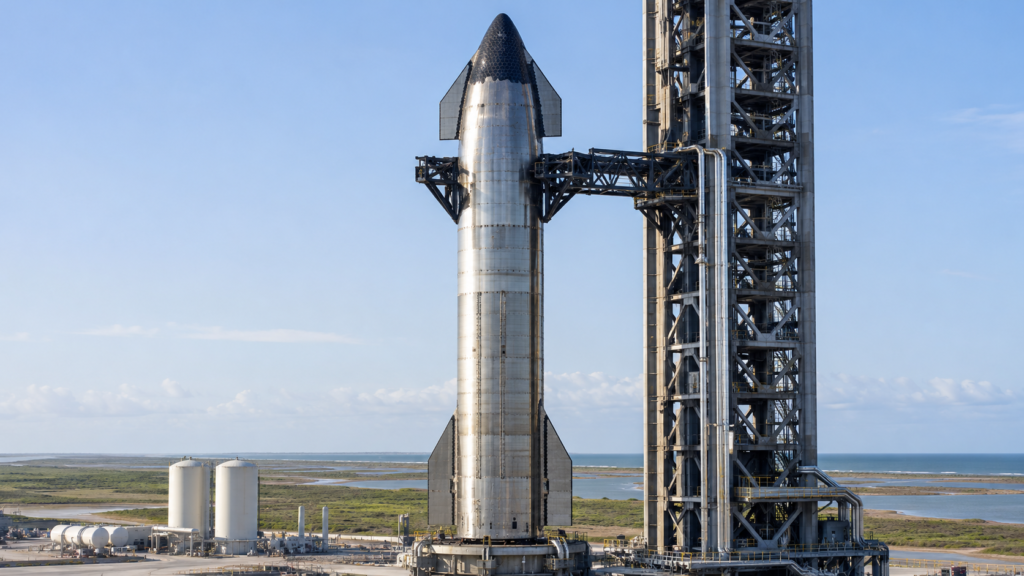
The upper stage completed its return and tower catch
The stainless-steel Starship spacecraft, also called the Ship upper stage, circled Earth 14 times before descending to its launch site. Associated Press reported that the vehicle spent about 22 hours in flight and released 26 Starlink satellites during the test.
The tower’s arms caught the returning vehicle and held it above the ground. SpaceX and NASA described the result as an important step toward returning and reusing the spacecraft, rather than landing it at a separate site.
The booster recovery did not succeed
Flight 15 had aimed to recover both the first-stage Super Heavy booster and the upper-stage Starship at the launch tower. The booster failed to make its return after Friday’s liftoff and was lost over the Gulf of Mexico, according to AP and Reuters. The successful Ship catch therefore did not amount to a complete two-stage recovery.
SpaceX said the booster’s guidance system detected it was out of position and ended the recovery attempt. Engineers are investigating the cause. The separate outcomes matter: the test demonstrated a tower catch for the upper stage, while the booster’s return remained unresolved on this flight.
What the test changes—and what it does not
Returning both stages to the launch site is central to SpaceX’s goal of making Starship fully reusable. A successful catch can be a step toward shorter turnaround and repeated flights, but the test alone does not establish routine reuse, operating costs or readiness for crewed missions. NASA is relying on Starship for future Artemis lunar landings, which require additional development and testing.
The flight also shows why “double catch” is a useful shorthand but an incomplete description of the result: the Ship upper stage was caught, while the booster was not. The Globuzz recently covered another major space milestone, as Voyager 1 approaches one light-day from Earth.
Sources
Sources: Associated Press, Nov. 14, 2026; Reuters report, republished by Yahoo Finance; SpaceX Flight 15 mission page.
